
Health literacy is the ability to find, understand, and use health information. It shapes how well someone can do things like read a prescription label, understand a nurse’s instructions, or decide when to call a doctor. Nearly nine out of 10 adults in the U.S. struggle with health literacy, which makes it one of the most impactful factors in patient outcomes.1
But health literacy isn’t only driven by the skills patients bring to the table. It also depends on the design of the systems and information they use—from forms and patient portals to apps and AI tools. That’s where healthcare organizations come in.
Every October, Health Literacy Month shines a light on this gap, encouraging organizations to examine how well they’re meeting health literacy needs among the people they serve. This year, we sat down with three experts to talk about health literacy, how it’s changing in the era of AI, and how the industry can keep up.
“Information only matters if people can find it, trust it, understand it, and act on it.”
Literacy, layered
Health literacy’s core definition hasn’t changed in recent years. But the environment around it has.
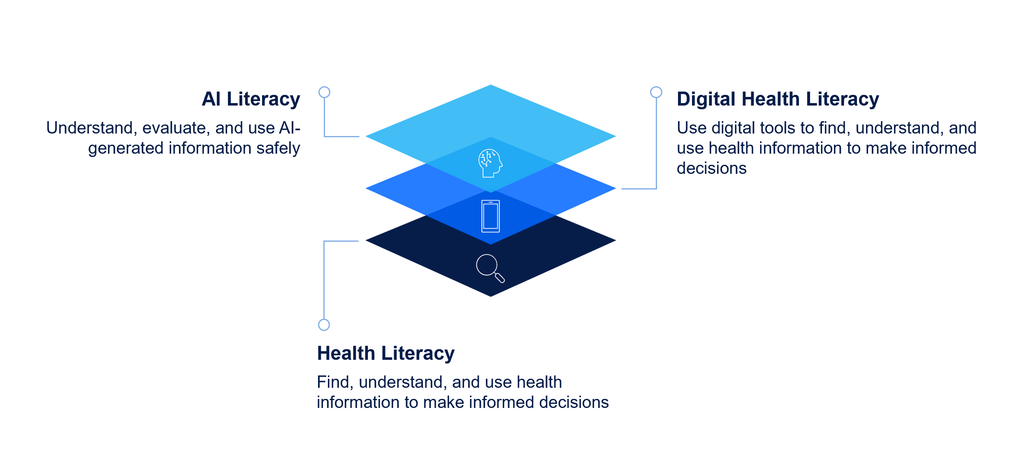
Today’s information environment has gotten far more complex since the conversation about health literacy began, and generative AI is a big reason why. Lori Hall, founder and CEO of Patiently Speaking, breaks that complexity down into three distinct layers: “Health literacy is still the foundation: Can people find, understand, and use health information to make a decision or take action? Digital health literacy adds another layer because now people also must navigate the technology itself. AI adds something different again because now the technology is talking back.”
Anna Subrizi, Senior Director, Patient Empowerment at Bristol Myers Squibb, sees a similar stack. “When people use AI tools for health information,” she notes, “they need the skills to understand where the information comes from, critically evaluate it, and make informed judgments about whether to trust it, including whether any human oversight was involved.” That’s a sophisticated set of skills for anyone to hold at once.
A new front door
A 2026 Kaiser Family Foundation poll found that a third of adults (32%) are now turning to AI for health information and advice.2 Most cite wanting quick, immediate answers (65%). Many also want to look something up before seeing a provider (41%) or simply feel more comfortable researching health questions privately (36%).
Searching for health information with tools like ChatGPT, Claude, or Gemini might look like a new trend. But Subrizi frames it as the same behavior on a new channel. Patients and care partners search for health information online, join patient Facebook groups, and watch health content on TikTok. Now they’re using AI as “another front door”—a new way to get to the information they’re already looking for.
The difference is that this front door talks back. Karen Komondor, President of the US Health Literacy Association, pointed to a key trade-off: AI lets health organizations produce information faster and at higher volume, but it can also increase the complexity for patients. Hall put it more bluntly, saying, “AI adds another layer because the response is generated specifically for you and can sound incredibly certain, even when there is uncertainty underneath it.”
Meeting patients where they are
This tension sat at the center of every conversation we had: the people who might benefit most from AI’s ability to translate, simplify, and explain are often the ones who are least prepared to understand the implications of AI-generated information.
Faced with that gap, the instinct is often to expect that patients will automatically level up and become more discerning consumers. Subrizi pushes back on that instinct directly, noting, “We shouldn’t be asking patients to become more sophisticated when they’re already trying to navigate their healthcare journey.”
We’d take that a step further. Komondor draws a direct comparison to clinical trials, where pharma already treats patient involvement as mandatory, with real requirements and real accountability. “Why,” she asks, “are we not setting similar requirements when it comes to health literacy?” It’s a question our industry should be asking itself. At Lumanity, we see organizational health literacy—the idea that institutions and health care systems bear responsibility for making information accessible, understandable, and actionable—as both an important part of an organization’s values and an industry-wide standard.
Hall offered a practical test for whether an organization is doing this work well: “The difference is whether health literacy is treated as a strategic design principle or just a finishing step. If you create a complex digital or AI experience and then ask someone at the end to make the language simpler, that’s not really health literacy.” Organizations doing it right ask foundational questions early—who is this for, what could confuse them, where might they get stuck—before they build, not after.
“The difference is whether health literacy is treated as a strategic design principle or just a finishing step. If you create a complex digital or AI experience and then ask someone at the end to make the language simpler, that’s not really health literacy.”
Lori Hall, Founder and CEO, Patiently Speaking
What comes next
AI is reshaping the health information landscape, and fast. But the core tenets of health literacy haven’t changed: information only matters if people can find it, trust it, understand it, and act on it.
This October, as we mark another Health Literacy Month, we’re watching this space closely and continuing to embed health literacy principles in our patient communication work. We want to hear from you: Does your organization address health literacy as a design principle or a finishing step?
With thanks to our contributors: Lori Hall, Founder and CEO, Patiently Speaking; Anna Subrizi, Senior Director, Patient Empowerment, Bristol Myers Squibb; and Karen Komondor, President, US Health Literacy Association.
References
1. An introduction to health literacy. Network of the National Library of Medicine. Accessed October 5, 2026. https://www.nnlm.gov/resources/public-health-resources/intro-health-literacy
2. Montero A, Montalvo III J, Kearney A, Valdes I, Kirzinger A, Hamel L. KFF tracking poll on health information and trust: use of AI for health information and advice. March 25, 2026. Accessed October 5, 2026. https://www.kff.org/public-opinion/kff-tracking-poll-on-health-information-and-trust-use-of-ai-for-health-information-and-advice/