
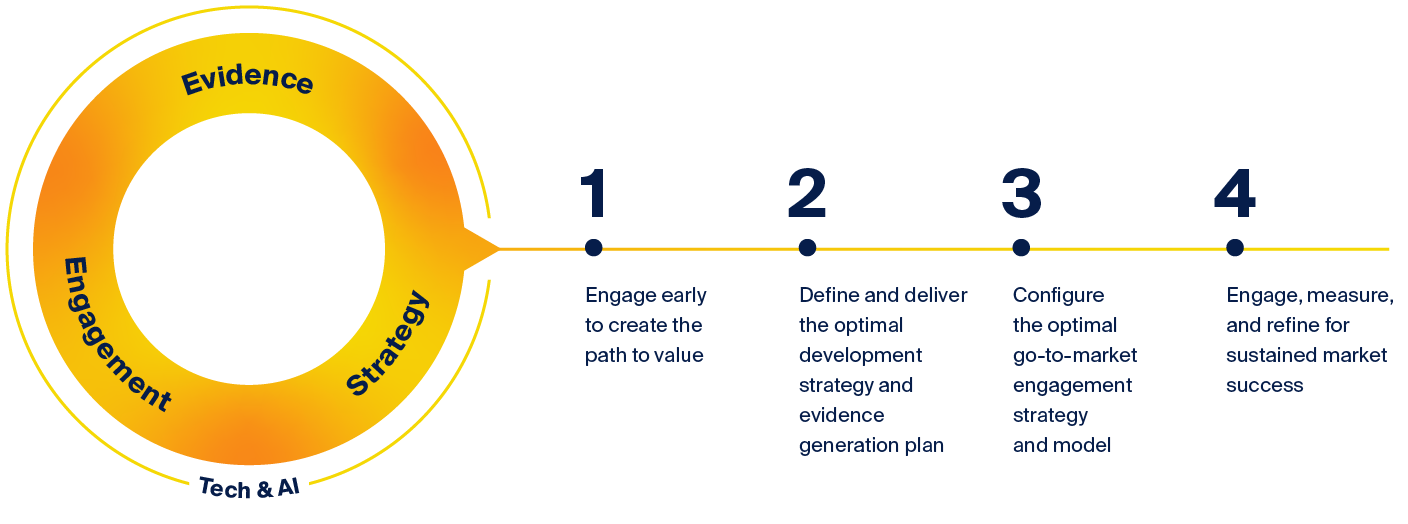

Our Approach

Our capabilities in strategy, evidence, and engagement converge at key inflection points to create breakthrough value. We ensure that every strategic decision at these moments contributes to a medicine's success in reaching patients, improving outcomes, and enhancing clarity and confidence for all stakeholders.

How we deliver breakthrough value across the development path

Value Inflection Points
1.

Engage Early to Create the Path to Value

The first step to commercializing a successful medicine is understanding the unmet needs and defining a clear path to value. We lay the foundation for asset success by identifying market challenges and medical priorities and shaping a differentiated value proposition.

Discover our approach
Define market and patient needs
  • Conduct a comprehensive market analysis to understand current and future trends
  • Identify and map unmet needs across patient populations
  • Assess market opportunities and prioritize indications based on potential impact
  • Conduct health economic assessments to evaluate treatment cost-effectiveness and align stakeholder priorities and market access requirements
Perform in-depth technology and scientific assessments
  • Evaluate new scientific discoveries for regulatory compliance and potential clinical applications
  • Utilize real-world data to evaluate the effectiveness and impact of emerging technologies and modalities
  • Develop and validate clinical outcomes assessments to measure treatment effectiveness and patient benefits
Understand and navigate competitive and regulatory changes
  • Monitor and analyze market trends and competitor activities to provide actionable insights for strategic decision-making
  • Conduct early development feasibility assessments and strategic plans to position assets effectively in the competitive landscape
  • Assess regulatory landscapes and anticipate policy changes to inform market access strategies and maintain competitive advantage
  • Create global regulatory strategies and engage early with regulatory bodies to ensure smooth regulatory pathways and compliance
Define asset value proposition and stage-gating criteria
  • Identify and quantify market opportunities for asset development, ensuring strategic alignment with commercial goals and market potential
  • Develop a compelling value proposition based on unmet needs and market analysis to support pricing and reimbursement strategies
  • Optimize medical organization strategy to align with the asset’s value proposition, ensuring effective stakeholder engagement and evidence dissemination
  • Establish early brand propositions and foundational brand components to create a strong brand identity and market positioning from the outset
Identify program value drivers and risks
  • Conduct market understanding and early-stage Target Product Profile (TPP) assessments, laying the groundwork for strategic planning and opportunity identification
  • Identify and quantify key value drivers and potential risks in asset development, ensuring strategic alignment and maximizing market potential
  • Evaluate stakeholder needs and perform health economic assessments, devising strategies to mitigate risks and bolster the value proposition
  • Perform detailed market access landscape assessments and policy mapping to identify regulatory challenges and opportunities for optimal market entry
2.

Define and Deliver the Optimal Development Strategy and Evidence Generation Plan

Optimizing the development of your asset requires a harmonized, evidence-backed strategy. We ensure that your development plan maximizes differentiation and commercial viability, setting the stage for success.

Discover our approach
Understand all stakeholder requirements
  • Conduct comprehensive stakeholder analyses, identifying needs and expectations to inform strategic planning
  • Engage with key stakeholders, gathering insights and aligning on priorities to ensure coherent strategy development
  • Evaluate the regulatory landscape, understanding requirements and expectations to ensure compliance and strategic alignment
  • Assess payer and market access needs to ensure alignment with stakeholder demands
Build a strong value-based asset proposition
  • Develop a compelling value proposition based on market and stakeholder analysis
  • Integrate health economics and outcomes research, ensuring the value proposition is robust and evidence-based
  • Create a strategic narrative to effectively communicate the asset’s value to diverse stakeholders
  • Align the value proposition with patient-centric outcomes, addressing patient needs and treatment relevance
Define asset data needs and generation strategy
  • Identify data requirements to support regulatory submissions and facilitate market access
  • Develop an integrated evidence-generation plan covering clinical, economic, and real-world data
  • Leverage real-world evidence to generate supportive data tailored to stakeholder needs
  • Ensure alignment of data-generation strategies with commercial objectives to maximize market potential
Set development and commercialization priorities and business case
  • Prioritize development activities based on market potential and strategic fit, ensuring focused resource allocation
  • Develop a robust business case to support investment decisions and optimize resource allocation
  • Align development priorities with regulatory and clinical strategies to ensure compliance and efficacy
  • Engage cross-functional teams to ensure cohesive planning and seamless execution
3.

Configure the Optimal Go-to-Market Engagement Strategy and Model

Creating the conditions for a high-impact market launch and growth plan requires meticulous planning and strategic alignment. Our experts help you configure the optimal go-to-market (GTM) strategy, ensuring internal readiness and external market alignment.

Discover our approach
Position brand and asset strategy
  • Develop a clear brand positioning and asset strategy aligned with market needs
  • Define the strategic communication imperatives and craft value messaging to effectively convey the brand’s benefits
  • Conduct a thorough market and competitive analysis to inform positioning
  • Align brand strategy with commercialization objectives and stakeholder expectations, ensuring cohesive market entry
Develop market access and pricing strategy
  • Conduct pricing and reimbursement landscape assessments to inform strategy and optimize access
  • Develop pricing corridors and market access strategies based on stakeholder needs and market conditions
  • Create a comprehensive market access plan to ensure optimal product uptake and sustained market presence
  • Engage with payers and regulatory bodies to negotiate pricing and access
Engage medical stakeholders
  • Develop a medical engagement strategy to build and strengthen relationships with key opinion leaders
  • Create tailored communications and educational materials to effectively address the needs of medical stakeholders
  • Implement a comprehensive thought leader engagement plan to facilitate meaningful interactions and collaborations
  • Conduct scientific narrative development and dissemination to support engagement and convey critical information
Embrace a strategic approach to patient engagement
  • Develop patient engagement programs aligned with stakeholder needs and expectations
  • Map the patient journey and experience to uncover strategic insights and improve patient-centered approaches
  • Incorporate patient insights into product development and commercialization strategies to enhance relevance and impact
  • Establish partnerships with patient advocacy organizations to foster engagement and support patient-focused initiatives
Design specialized organization
  • Conduct organizational diagnostics to identify gaps and develop a future-fit design to support strategic goals
  • Build organizational structures for scale up and development
  • Implement training and development programs to build and enhance specialized capabilities
Establish KPI framework across workflows
  • Define KPIs to measure success in achieving market access and payer alignment
  • Develop metrics to track medical stakeholder engagement and measure impact
  • Create KPIs to assess the effectiveness of brand communications on market penetration and awareness
  • Establish KPIs to evaluate the impact and reach of scientific communications
4.

Engage, Measure, and Refine for Sustained Market Success

Sustained market success requires continuous engagement, measurement, and refinement. We leverage ongoing stakeholder engagement, insight-driven strategy refinement, and real-world evidence to ensure your asset remains the clear choice.

Discover our approach
Engage and educate stakeholders
  • Develop and implement stakeholder engagement plans to build relationships and foster trust
  • Develop patient engagement programs to ensure that patient voices are heard and incorporated into strategic planning
  • Create tailored educational programs and materials to address the unique needs of different stakeholder groups
  • Create compelling brand communications to effectively convey key messages and build stakeholder awareness
  • Conduct educational initiatives to inform payers and market access stakeholders about the value and benefits of the asset
Develop a compelling scientific narrative to bring evidence to life
  • Create a strategic scientific narrative to communicate key evidence and insights
  • Develop core content, such as slide decks, abstracts, and manuscripts, to support evidence dissemination
  • Utilize visualizations and mechanisms of action/mode of delivery (MOA/MOD) to enhance the scientific narrative
  • Engage key opinion leaders to support narrative development and dissemination of the scientific narrative
Generate real-world data and insights
  • Conduct real-world data analyses to generate insights on disease burden and treatment patterns
  • Develop and maintain a robust data infrastructure to support ongoing evidence generation and analysis
  • Capture patient-reported outcomes that reflect patient perspectives
  • Leverage real-world evidence to inform regulatory strategies, post-approval studies, and continuous clinical decision-making
Manage performance and learnings
  • Track payer engagement and reimbursement outcomes to drive continuous improvement
  • Measure the impact of brand communications on market penetration and stakeholder awareness, informing necessary adjustments
  • Leverage patient feedback and insights to refine engagement strategies
Plan lifecycle and investment strategy
  • Identify and plan for lifecycle management opportunities, such as line extensions, new formulations, and indication expansions
  • Monitor and respond to market access and reimbursement changes to optimize lifecycle strategy
  • Develop a risk management strategy to address potential challenges and uncertainties throughout the product lifecycle